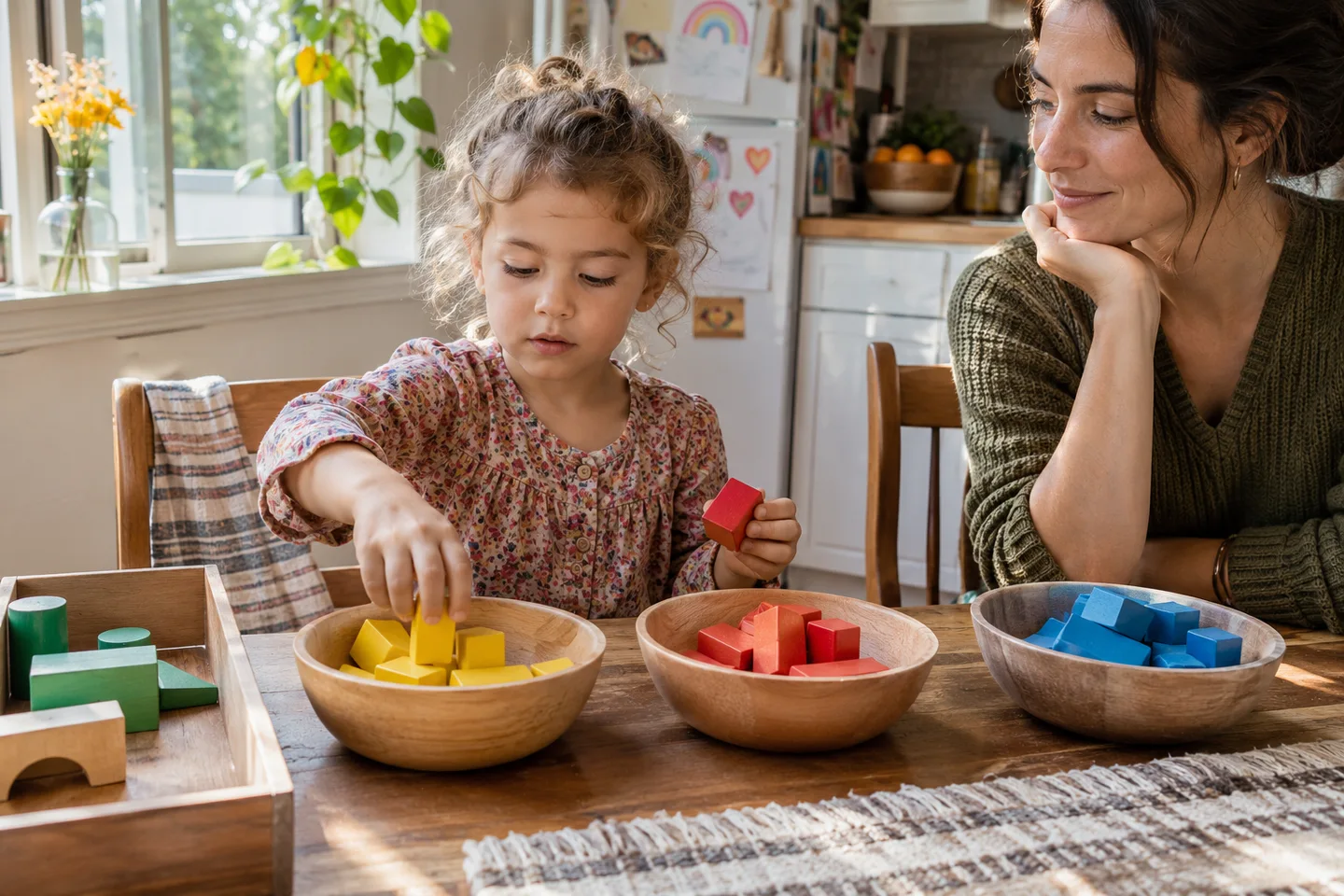
A red block lands in the blue bowl. Before correcting it, look at what the child is doing. Perhaps every long block belongs there. Perhaps that bowl is the bus and the block is a passenger. Sorting can reveal how children notice relationships, but only if adults leave enough room to see the rule the child has chosen.
A small table is enough for this activity. You do not need a matching set of expensive toys or a carefully arranged playroom. A handful of large blocks, two or three shallow containers, and a little attention give you a useful place to begin. The aim is a conversation about what belongs together, rather than a tray that looks correct to an adult.
Begin with fewer pieces
Choose blocks suitable for your child's age and abilities. Avoid pieces that could be swallowed, damaged toys with loose parts, and containers with sharp edges. Work at a stable surface with an adult nearby. If you have a toddler who still mouths objects, use only large items designed for that stage and stay within reach.
Start with six or eight pieces. Too many choices can hide the interesting part of the activity beneath a pile. Put two bowls on the table and ask, “How could we make two groups?” A child may immediately separate colors. Another may stack everything instead. You can follow that interest briefly, then invite a distinction between tall towers and short towers.
Let the first rule belong to the child
Watch a few moves before you speak. Once a pattern appears, describe it tentatively: “I notice these pieces are all long. Is that your group?” This gives the child a chance to confirm your guess or explain something you missed. It also makes clear that you are trying to understand, rather than waiting to catch a mistake.
If your child cannot yet explain the rule verbally, pointing and moving pieces still count as communication. Offer one block and pause. Where does it go? You can describe the decision in ordinary language. There is no need to introduce terms such as classification unless the child is already interested in them. Shared meaning matters more than vocabulary performance.
If one bowl attracts every block, ask whether it needs a particular job. It could hold all the pieces that have already been examined, while the second holds those still waiting. That arrangement is a real sorting system too. Naming the purpose can help an adult understand a pattern that initially looked like the child was ignoring the invitation. You can then ask whether another bowl would help with a different distinction. Leave the answer open. A child who invents a useful category has contributed an idea even when the category differs from the one you expected. The activity can follow that idea for a while before you suggest another way to arrange the same pieces.
Make an exception interesting
A block may fit more than one group. A long red piece belongs with red blocks under one rule and long blocks under another. Place it between the bowls and wonder aloud where it could go. Let your child choose. If the answer seems inconsistent, ask about the choice instead of insisting that there can only be one correct place.
You can also discover that a sorting rule is difficult to apply. Perhaps one piece looks partly orange and partly red. A third bowl might become the “not sure yet” place. Keeping uncertainty visible is useful. It shows that people can postpone a decision, compare again, or change a group when new information appears.
Change one thing at a time
When the first sort feels complete, take a photograph for your own private record or simply look at it together. Then return the pieces to the middle and ask whether there is another way. Shift from color to shape, from smooth edges to curved edges, or from pieces that roll to pieces that stay still on a flat surface.
Avoid changing every feature of the game at once. The same blocks make the new rule easier to notice. You might say, “Before, the red pieces stayed together. Now the round pieces stay together.” Compare one example from each arrangement. This small conversation makes the change understandable without requiring a long explanation from the child.
Use questions that invite evidence
Questions are most helpful when you do not fire them one after another. “What made you put that here?” can lead to an interesting answer. “What color is this? What shape is it? How many sides?” can quickly turn a shared activity into an examination. Leave quiet space after asking, and accept a gesture or a short answer.
Try making a genuine prediction yourself. “I think this one might roll because its side is curved.” Test the idea on the tabletop, keeping pieces away from the edge. If it does not behave as expected, say so. Adults can model checking a guess without making a dramatic lesson out of being wrong.
Adjust the challenge without adding pressure
For a child who wants an easier version, use very different pieces and name a single rule together. You might offer only red and blue blocks. Place one example in each bowl, then invite your child to continue. Stop before concentration runs out. A few thoughtful decisions are more worthwhile than finishing a large collection unwillingly.
For a child ready for more, combine two features. Ask for a group of blocks that are both red and long, leaving the others outside the bowl. Another option is to invite your child to design a rule for you to discover. Make a few deliberate guesses and explain your reasoning. The child becomes the person checking whether your idea fits.
Fit the game into a shared room
A tray or washable mat can define the activity space without making the room feel divided. Keep unused toys out of the immediate area if they are distracting, but do not expect complete silence. In a home used by several people, learning often happens beside ordinary conversation, cooking, or a sibling's homework.
If two children join in, give each a small group first. Later they can compare their rules. One child might be interested in color while the other wants to build roads. They do not need to reach agreement immediately. You can provide separate containers and invite them to show each other what they noticed when they are ready.
Notice the thinking and finish simply
Describe something specific at the end: “You changed the rule when you found another curved piece,” or “You checked both bowls before choosing.” These observations tell the child what you saw without assigning a label such as clever or advanced. Avoid comparing the result with a sibling's performance or using the game to judge development.
Cleanup can continue the idea in a practical way. Blocks return to one box and bowls to another cupboard. If the child is tired, share the job rather than demanding a perfect final sort. Next time, begin with a different question or let the blocks become a building project. The bowls have done their work when they have made noticing, explaining, and revising feel like ordinary parts of play.
Before putting everything away, you might ask the child to select one piece that was hard to place. Talk about what made it tricky. Keep the conversation brief and follow the child's interest; some days there will be an elaborate answer and other days none. That single ambiguous piece can be more revealing than a whole bowl of easy matches. It offers a natural reason to revisit a decision later, when another block or a different rule changes what seems sensible.
For general educational information. Adapt ideas to your family and consult a qualified professional for individual concerns.