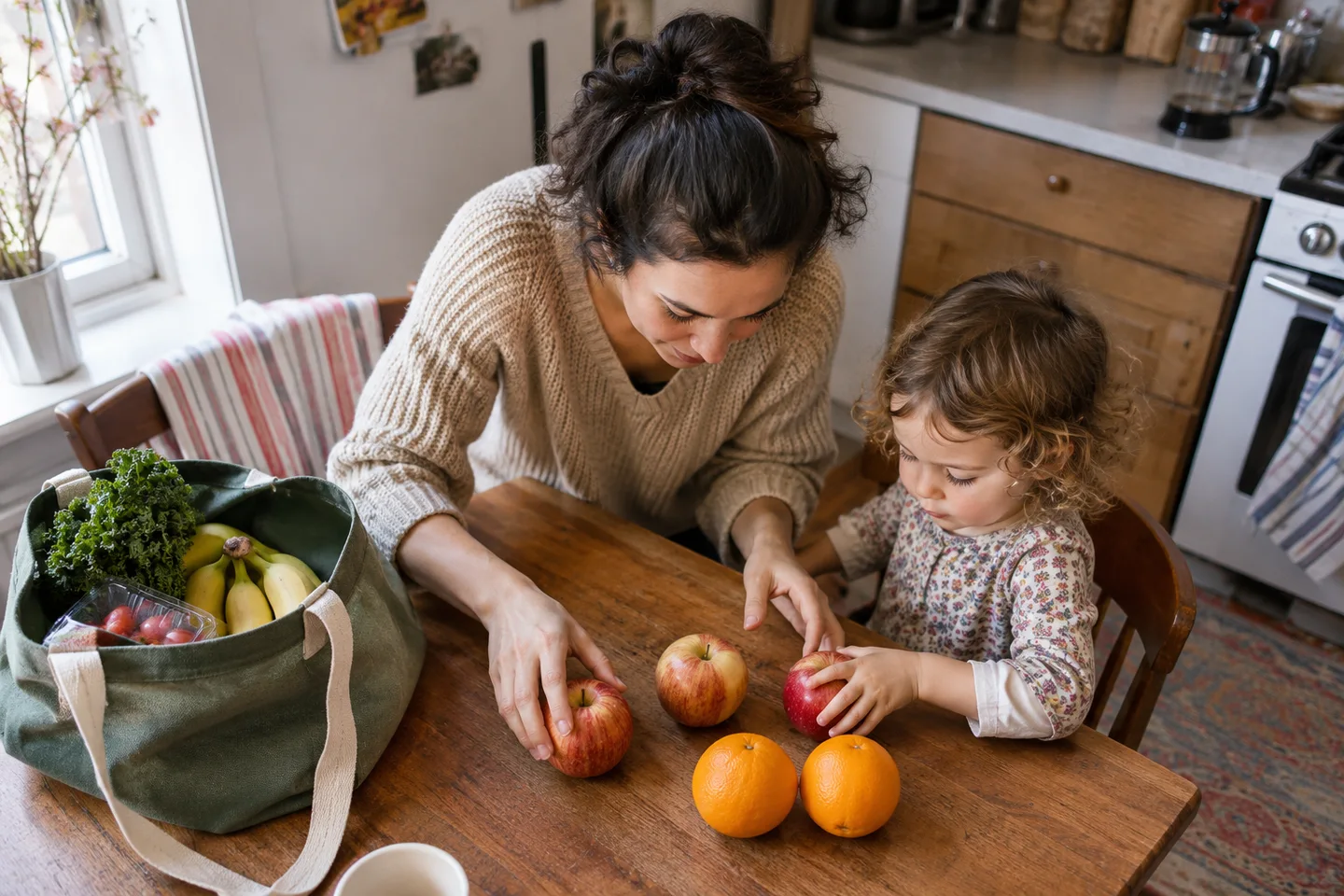
A grocery bag often arrives with a ready made collection of things to compare. Three apples, two oranges, a loaf of bread, and a packet of pasta are ordinary household items before they become anything educational. That is their advantage. A child can see why counting or comparing might help someone make a decision.
Keep this activity short enough that food can be stored promptly and the kitchen can return to normal use. It works best as a conversation while unpacking, with one small part moved to the table. You are not trying to teach every mathematical idea hiding in the shopping. Choose a question that connects to what your child has already noticed.
Pick food that can wait a moment
An adult should deal first with food that needs refrigeration and any heavy or breakable items. Set aside a few whole fruits or unopened lightweight packages. Keep raw meat, sharp packaging, cleaning products, and anything unsuitable for handling out of the activity. Wash hands and surfaces as you normally would before touching food.
If food handling is inconvenient, use a simple drawing of the groceries or large toy items instead. The mathematical conversation does not depend on real fruit. In a household managing allergies, follow the family's established precautions and avoid introducing food as a learning prop just because it looks attractive in a photograph.
Count to answer a real question
Ask whether there are enough apples for the people who want one. Place a marker for each person, such as a large coaster, and match one apple to each marker. This gives counting a purpose. If there is an apple left over, talk about what that means for your household rather than rushing to write a number sentence.
When your child counts aloud, watch whether each item is touched or moved once. If a piece gets counted twice, spread the fruit out and try again together. You can say, “This apple has already had a turn.” Keep the correction concrete. Reciting a long number sequence and keeping track of separate objects are different tasks.
A receipt can be another useful object, but keep the task narrow. With an older child, find one item that you both recognize and locate its price together. Explain that abbreviations can make the line difficult to identify. If the match is uncertain, leave it uncertain rather than assigning a price by guesswork and building further calculations on it.
Compare without making a competition
Place apples in one row and oranges in another. Ask which group has more and how you could check. A child may judge by how much space the rows occupy. Move the apples close together and spread the oranges apart. Wonder whether moving them has changed how many there are, then match the items in pairs.
The mismatch is the useful part. One orange may be left without an apple partner. Talk about that visible evidence instead of insisting the child accept your answer. If the question is too difficult, use two items and three items first. If it is easy, let your child arrange the groups to try to fool you.
Make a little shop with honest limits
A pretend shop can extend the activity after the food is put away. Draw three items on separate cards and give them simple whole number prices. Use large paper tokens rather than small coins if younger children are present. Explain that these are made up prices for the game, not a guide to what groceries actually cost.
Let your child choose what to buy with a small number of tokens. Ask what would happen if one more item joined the basket. Do not turn a missed calculation into a lesson about real family finances. A pretend shop is a place to explore choices, totals, and change in manageable amounts, with no need to discuss private household spending.
Look at the shape of the package
A cereal box and a cylindrical container offer another kind of comparison. Ask which one stands easily, which has a curved surface, and which would fit on a particular shelf. Keep the containers closed if the contents should not be handled. You can trace a clean package base on paper and compare the shapes left behind.
Avoid suggesting that the biggest package necessarily contains the most food or offers the best value. Packaging, contents, and price are different questions. With an older child, notice that distinction explicitly. A tall empty box may look impressive while holding very little. This is a useful reason to look for information rather than trust the first visual impression.
Explore sharing through small arrangements
Imagine that two people want to share four drawn apples. Move the pictures between two paper plates, one at a time, and compare the groups. Ask whether the share looks even. Then try five pictures. Your child may suggest saving one, inviting another person, or drawing a cut through the final apple. Discuss the suggestion before introducing formal vocabulary.
Use pictures when the problem would otherwise require cutting food. Any actual cutting should follow your normal adult supervision and age appropriate kitchen practices. There is no need to prepare an extra snack to prove a mathematical point. A drawing can be moved, changed, and used again without creating food waste.
Let written numbers arrive naturally
If your child wants to record the arrangement, offer a plain piece of paper. They might draw circles, make tally marks, write numbers, or dictate a sentence. All of these can preserve an idea. Ask what their marks mean rather than judging whether the page resembles a school worksheet. You can add a label if they request help.
An older child might draw a tiny shopping list with quantities beside the items. Keep the list short and connected to a real meal or snack. Next time, compare the list with what came home. Did everything arrive? Was something substituted? Such ordinary differences make a useful conversation about reading information and adjusting a plan.
Keep room for uncertainty
Children sometimes ask questions the groceries cannot answer. Which fruit is heavier? Which would keep longer? What did each item cost? Decide whether you have a safe and sensible way to check. If you do not, say what information is missing. A price receipt may answer one question while a kitchen scale answers another.
You do not need to invent an answer to keep the activity moving. “We would need to weigh them” is a complete response. It helps distinguish a guess from a measurement. Avoid broad claims about nutrition or health when the activity is simply about quantities. Those questions need appropriate information of their own.
Finish with something useful
Invite your child to carry a light item to its usual storage place or put the pretend shop cards into an envelope. Notice a specific action: “You paired every orange with an apple to check.” This recognizes the method, not just the final answer. The groceries can now return to being groceries.
On another day, a different bag may suggest a different question. There might be enough rolls for lunch, containers that fit inside a cupboard, or a list with one missing item. The habit you are building is simple: notice a practical problem, choose a way to check it, and see whether the answer helps. A small kitchen table is plenty of space for that.
If your child would rather leave the conversation after two minutes, let the activity end there. You can continue putting things away without presenting departure as failure. Repeating one meaningful comparison on several ordinary days often feels more natural than stretching a single unpacking session into a long lesson. Leave the child with a clear connection between the question and the decision it helped you make.
For general educational information. Adapt ideas to your family and consult a qualified professional for individual concerns.