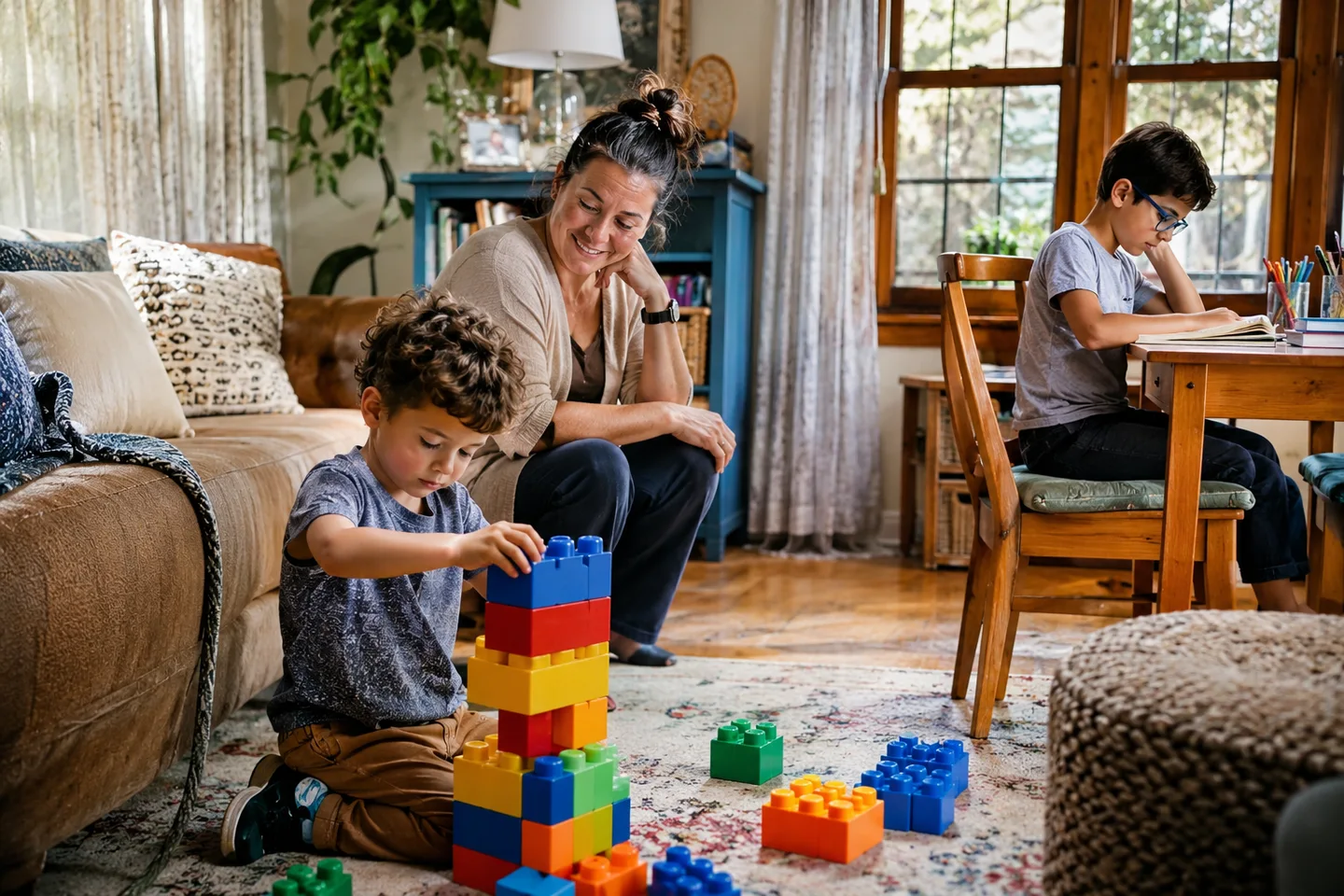
One child needs a place to read. Another wants to build a road across the carpet. The room is also where the family eats, talks, and folds laundry. In a small home, the answer is rarely a separate room for every activity. It is a workable agreement about how people use the space they share.
Children of different ages can have different needs without either being treated as the obstacle. An older child may need protection for a project with small pieces. A younger child may need accessible materials and a nearby adult. Begin by observing the points where activities collide, then make a few practical changes that address those collisions directly.
Name what the room must do
List the regular uses of the room with the children. Keep the list concrete: reading, building, eating, moving through the doorway, and sitting together. Ask which activities can happen at the same time and which need a changeover. A table cannot usually serve a messy project and dinner simultaneously, but a book and a block road may coexist.
Do not ask children to solve constraints they cannot control, such as the size of the home. Instead, offer choices within the available space. “The table needs to be clear before dinner. Would the project be easier to move on a tray or to photograph and rebuild?” The choice gives them influence without disguising an adult requirement.
Make boundaries visible
A small rug, a tray, or a place mat can mark an activity area. These do not need to be matching products. A folded towel may define where large blocks stay, while a plain folder marks an older child's paper work. The boundary should be easy to recognize and possible to maintain without constant adult reminders.
Keep walking routes, doors, heaters, and electrical equipment clear. Avoid improvised barriers that could tip or create climbing opportunities. In a room used by younger children, adults should control access to small parts and other unsuitable materials. A visible boundary is a social cue; it does not replace age appropriate storage or supervision.
It can help to distinguish a private item from a shared material explicitly. A child's drawing may need permission before touching, while a common box of large blocks may be available to everyone. Discuss the difference with real examples from the room. Clear ownership expectations reduce the chance that children interpret every boundary as a judgment about whose activity matters more.
Protect work without making it untouchable forever
A child may need to leave a drawing or model unfinished. Agree on a limited place for work in progress, such as a high adult managed shelf or a lidded box suited to the materials. Add a simple name card if that helps. The purpose is to preserve effort while acknowledging that the room belongs to everyone.
Set a review point rather than promising indefinite protection. “We can keep this on the tray until tomorrow evening, then decide what happens.” Some projects can be dismantled after a photograph for the family's private record. Others can be stored flat. Let the maker help decide what is essential to keep and what can return to shared use.
Give the younger child a real activity
Offering a younger child an empty promise to join later often creates more tension. Put suitable large materials nearby so they can do something of their own. If the older child is drawing a map, the younger child might use broad crayons on a separate sheet. The activities can relate without requiring identical tools or outcomes.
Avoid presenting the younger child's version as inferior. “These are your large blocks” is clearer than “You are too little for the proper set.” Adults should make safety decisions, but those decisions can be explained without turning age into a ranking of importance. The younger child's activity deserves space and attention within the agreement too.
Give the older child a way to ask
Older children should not have to guard their work continuously. Offer a phrase they can use before frustration rises: “I need help keeping this area clear.” Then respond. Expecting them to tolerate every interruption in the name of being older can make shared space feel unfair and put them in a supervising role they did not choose.
At the same time, help them state limits respectfully. “Please ask before touching my drawing” is more useful than a general command to stay away. If an activity uses materials unsuitable for the younger child, schedule it when an adult can supervise and store the materials promptly afterward. Safety arrangements remain adult responsibilities.
Plan for different kinds of sound
Perfect quiet is unlikely in a family room. Decide what kind of sound a task actually needs. Reading independently may be possible with ordinary conversation, while listening to a recorded lesson may require a short quieter period. Tell everyone when that period begins and ends, and offer another activity to anyone who would otherwise be left waiting.
Do not assume headphones solve every problem. They may be unsuitable for a particular child or task, and they do not protect a project from physical interruption. Try changes in timing and seating first. An older child facing a plain wall may find concentration easier than one looking directly at a busy play area.
Use changeovers as shared work
Give a clear warning before the room changes purpose. “In ten minutes the table becomes our eating space.” Point to where each project can go. A portable box or tray makes the transition easier, but a simple stack of paper with a clip may be enough. Choose storage that matches what the family actually does.
Divide cleanup by manageable actions rather than age based assumptions. One child can collect large blocks while another puts papers in a folder. Adults can move heavier or fragile items. If a child is upset about stopping, acknowledge the unfinished part and help preserve it where possible. The boundary can stay firm without dismissing their investment.
Revisit the agreement after a real problem
When something gets knocked down or mixed up, attend to the immediate situation first. Later, ask what would have prevented it. Was the building area too close to the doorway? Were two children using the same box for different purposes? A better arrangement is often more effective than repeating a broad instruction to be careful.
Children can help test a change for a few days. Move the tray, add a clear label, or choose a different time for a delicate project. Ask each child whether the change helped. You may need more than one adjustment. The goal is an agreement people can use, not a perfect floor plan drawn once and never reconsidered.
Notice fairness in practical terms
Fairness does not always mean equal square footage or identical materials. It means each person has a reasonable chance to do something important to them, with support suited to their needs. Explain unequal arrangements specifically. “This shelf is higher because those pieces need adult access” is easier to understand than “That is just how it is.”
A shared room will still have crowded afternoons. What makes it workable is the confidence that limits can be stated, projects can be protected for a while, and problems can lead to useful changes. A small home can offer those conditions. The furniture matters less than the clear, repeatable ways people make room for one another.
Before buying new storage, try the arrangement with containers already available. Watch whether children can see what belongs where and return it without complicated sorting. If the system requires an adult to interpret every box, simplify it. A plain shelf that is used consistently is more helpful than a beautiful organization scheme nobody can maintain after a busy day.
For general educational information. Adapt ideas to your family and consult a qualified professional for individual concerns.