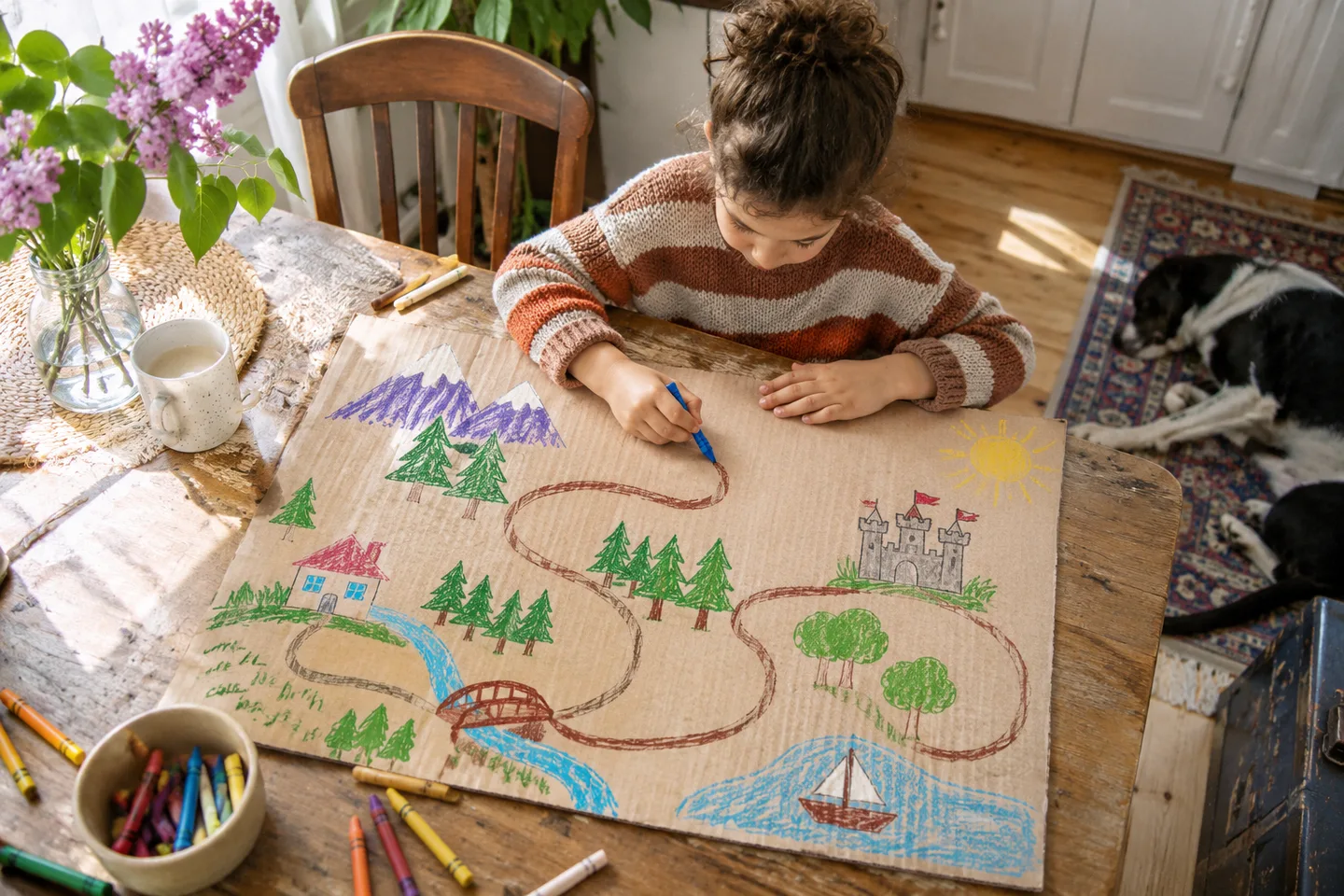
The story begins at a house and ends at a pond, but the interesting part is the journey between them. A cardboard story map gives that journey a visible shape. A child can draw places, move a large marker along a route, and decide where the next event happens. The result can be rough and still hold a surprisingly elaborate tale.
This activity suits a small home because the map can lie on a table and slide into storage afterward. It uses a clean piece of reused cardboard and ordinary drawing materials. You can base it on a familiar book or invent a story together. The aim is to make places and events easier to connect, not to produce a geographically accurate map.
Prepare a simple surface
Use clean, dry cardboard from suitable packaging. An adult should remove staples, sharp edges, tape with loose pieces, and any unsuitable material. Avoid packaging that held chemicals or food likely to cause hygiene or allergy concerns. Choose a piece small enough for the child to reach across comfortably without leaning over the table.
Broad crayons or age appropriate markers work well. Test them in a corner if the surface is glossy. Keep cutting and other tool use under normal adult supervision. There is no need to build raised scenery or add small decorations. A flat map is easier to store and keeps attention on the story rather than the construction of a model.
Start with three places
Ask the child where the story begins, where something happens, and where it might end. Draw or mark three places. A circle can stand for a pond and a rectangle for a house. Let the child decide what the symbols mean. If they ask you to draw, follow their description and check that the result represents the place they intended.
Avoid filling the whole board immediately. Empty space leaves room for discoveries. A child may decide later that the route needs a shop, a bridge, or a place to rest. Starting small also makes it easier to tell a complete short story before adding details that are enjoyable to draw but difficult to connect.
If the map becomes crowded, turn the cardboard over or begin another small sheet rather than insisting every new idea fit. The child can choose one feature to carry forward. This offers a practical way to simplify while preserving continuity. A second map might show only the pond area, making room for events that were too small to draw on the original journey.
Give the traveler a purpose
A character needs a reason to move. Perhaps they are returning a borrowed book, carrying an invitation, or looking for a place to have a picnic. Keep the purpose simple and suitable for the child. A large paper marker can represent the traveler; younger children do not need small toy figures or pieces that could be swallowed.
Ask what the character needs to take and who might help. These questions link objects and people to the journey. You do not have to include danger or a frightening problem to make the story interesting. A closed path, a missing item, or a change in the weather can create a manageable reason to choose another route.
Draw the route after choosing the destination
Connect the starting place to the destination with a line. The child can make it straight, winding, or branching. Trace it with a finger and describe the order of places. If the line crosses itself, ask how the traveler knows which way to go. Add an arrow or a landmark if the child thinks that would help.
This is a story map, so distances do not need to match reality. A large house may be beside a tiny forest. Explain that the map helps you remember where events happen rather than measure a real journey. For an older child interested in map conventions, you can discuss a simple key while keeping that distinction clear.
Tell while moving
Move the marker slowly along the route and let the child narrate. Pause at each place. What happens here? Does the traveler receive information, change plans, or leave something behind? If the child lists places without events, offer one gentle prompt. “What makes the character stop at the shop?” Then leave space for their answer.
If the story wanders away from the drawn route, follow the child's interest and decide together whether to add a new place. The map is there to support the telling, not constrain every idea. You can also park a promising detail for another story if the child wants to finish the current journey first.
Use the map to solve a confusing part
Sometimes a character seems to arrive somewhere without traveling there. Point to the last known place and ask how they moved. The child may add a path, explain a ride, or revise the previous event. This makes a missing connection visible without treating the whole story as wrong. A small change can make the account easier to follow.
Another common problem is forgetting an object. If the character needs a book at the pond but left it at home, ask what they might do. Returning, borrowing another, or changing the plan are possible story choices. Let the child choose. The map offers a way to remember consequences while preserving imaginative freedom.
Invite another person to use it
A sibling or adult can listen to the story with the map in front of them. Ask the listener to identify one place they want to hear more about. The child can add a detail or explain the symbol. Keep the exchange friendly and specific. It should not become a performance judged for dramatic voices or sophisticated vocabulary.
You can also swap roles. The child points to a route while the adult invents a short story, then the child decides what to change. This shows that the same map can support different accounts. A familiar landmark may have a new role, and a route used once may be skipped entirely in the next version.
Add words only where they help
Labels can identify places, a title can name the journey, and a short note can preserve a favorite event. Offer to write dictated words or provide a separate example for copying. Do not require conventional spelling before the child can continue. Drawings, marks, gestures, and spoken explanations can all contribute to the map's meaning.
For an older child, a small key may explain repeated symbols such as trees or bridges. Ask whether another person could understand it. If not, revise the key together. The question is practical: does the information help a reader follow the map? More writing is not automatically better if it makes the surface crowded and harder to use.
Store a map that can change
Let the cardboard dry if needed, then store it flat in a suitable place. Keep the large marker with it in an age appropriate container. Take a private family photograph only if that is useful and the child agrees. The physical map can be reused, revised, or recycled when interest has moved on.
Next time, offer a different starting place or ask what happens if one path is closed. The map may eventually become a board for several connected stories. Its value is in the conversations it makes possible: choosing a purpose, remembering where things are, and explaining how one event leads to another. Clean cardboard can hold all of that without needing a permanent place on the floor.
Before storing it, ask the child to point to the part they would keep unchanged in another story. That choice may reveal a favorite setting, an amusing event, or a route they find satisfying. You can use that detail as a starting point later, preserving continuity while leaving the next journey open to invention.
For general educational information. Adapt ideas to your family and consult a qualified professional for individual concerns.