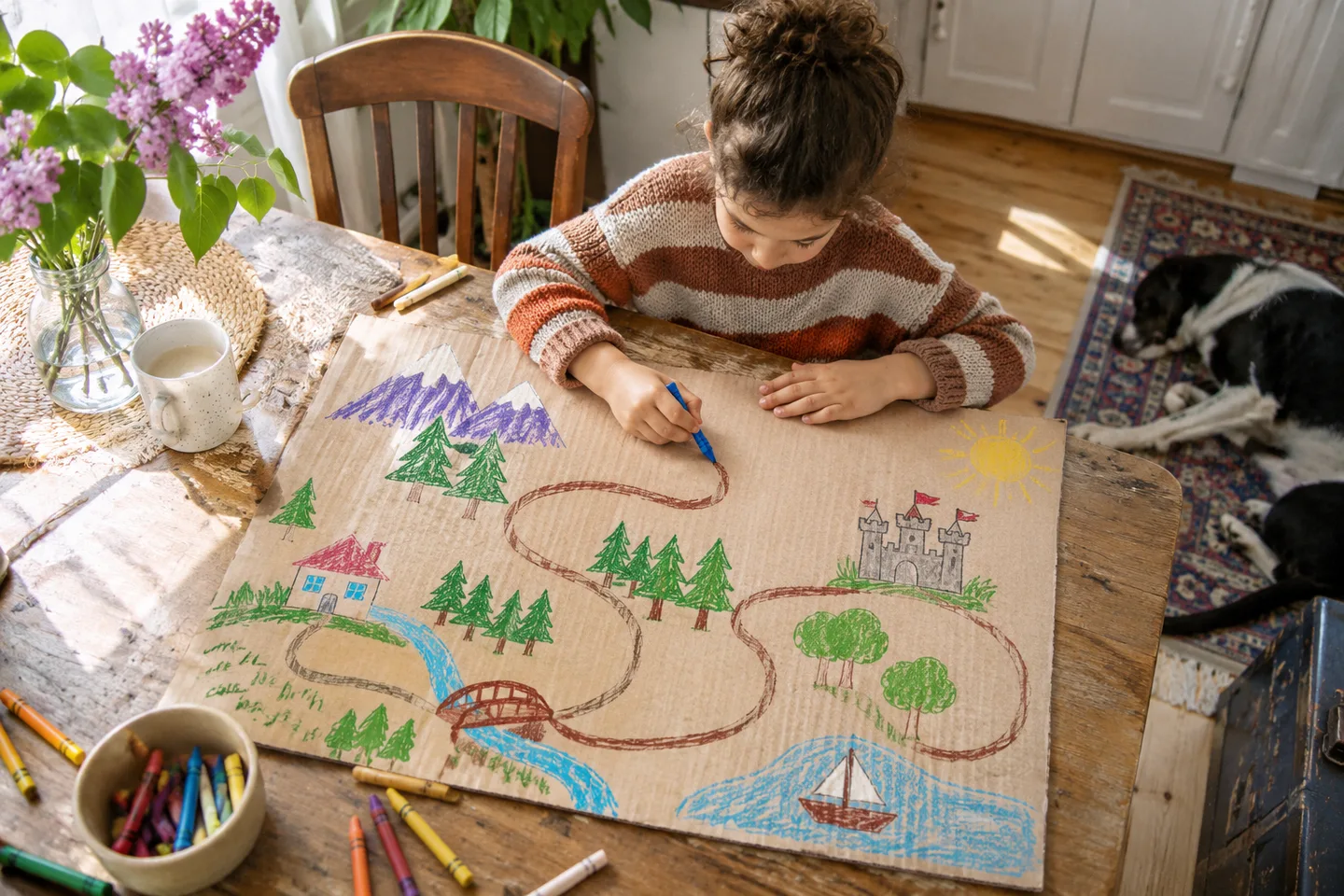
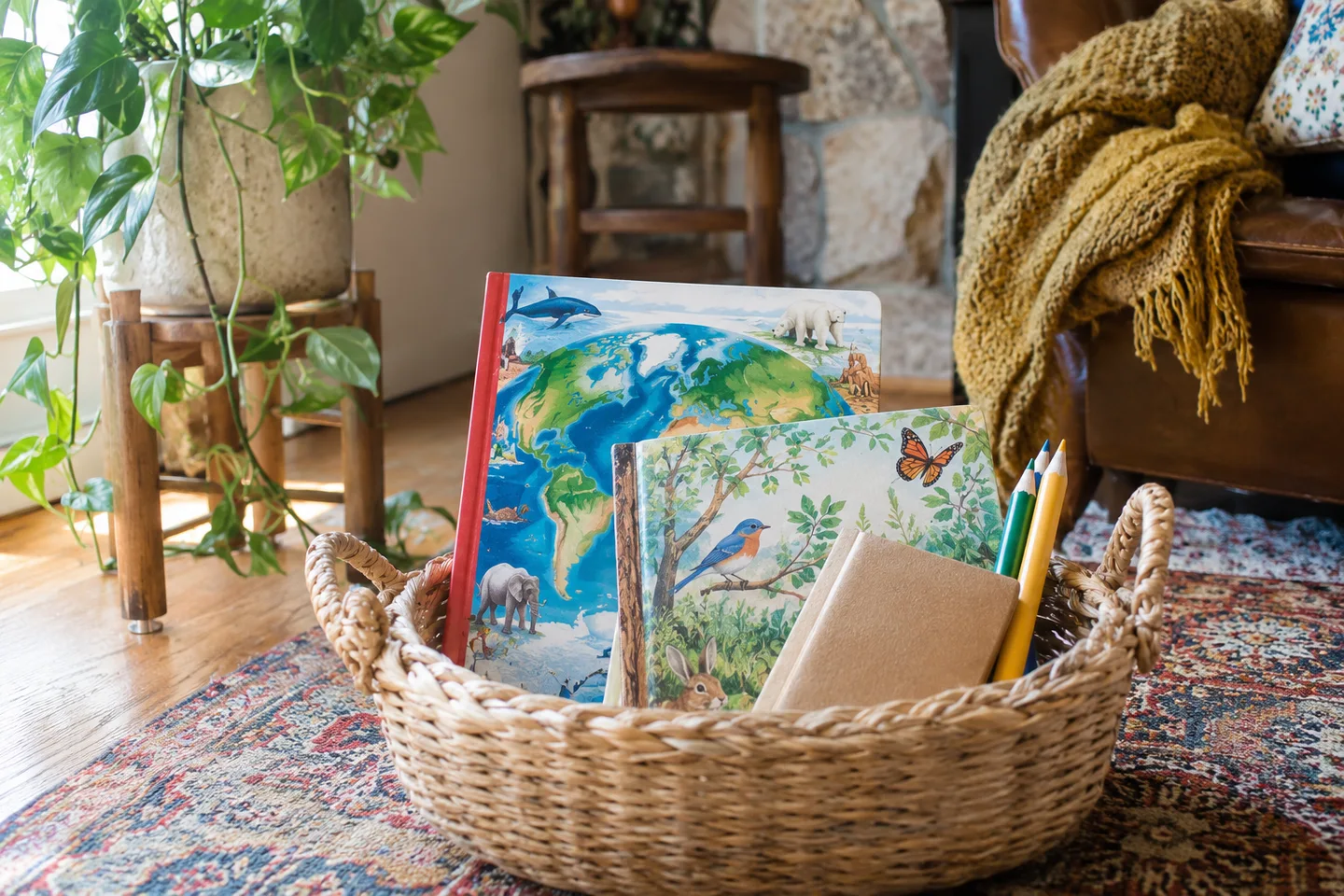
“Where does this river go?” The question arrives while a child is looking at a picture, not while an adult is preparing a lesson. If a useful book is within reach, there is a chance to follow the question before attention moves elsewhere. A small reference basket can make that first step easier in a home without a dedicated study area.
The basket does not need to contain an answer to everything. Its purpose is to offer a few dependable starting points and somewhere to keep questions that need more work. A child atlas, an illustrated book about the natural world, a simple dictionary, and a plain notebook may be enough. Start with what your family already owns or can borrow.
Choose questions before choosing books
For a week, notice the questions that come up naturally. Are children asking about places, unfamiliar words, machines, animals, or how ordinary things are made? Write down a few examples. This makes selection more specific than buying a large set of reference books simply because they are labeled educational.
Choose one or two areas that currently interest the child. A useful book should let them find a small piece of information without reading every page in sequence. Look for clear headings, an index or contents page, helpful illustrations, and language you can explain together. The most impressive looking volume is not necessarily the most usable one.
Check the information and the fit
Look at the publisher, publication date, author information, and any notes about sources. Dates matter differently for different subjects. A book about basic shapes may remain useful for a long time, while maps, political boundaries, technology, and other changing topics may need more recent checking. Do not assume every printed statement is current because it appears in a reference book.
Consider how the child will use it. Can they hold it comfortably? Are the pictures large enough to discuss? Does it invite questions without making sensational claims? For health, safety, or other decisions with significant consequences, a general children's book is not a substitute for suitable professional guidance or an authoritative current source.
A bookmark made from a plain strip of card can hold the page while you return to the original question. Do not rely on folded corners or leave a heavy object inside the book. Let the child decide whether a discovered page deserves a note in the notebook. Recording the page number can make a later search faster without requiring a copied paragraph.
Make the basket small enough to handle
Use a stable, accessible container that does not block a walkway. Avoid overfilling it until books become difficult to remove. If a child cannot lift the basket comfortably, leave it in place and carry individual books. A low shelf can work equally well. The container is useful only if it makes the books easier to use.
Include a notebook and a few age appropriate writing tools. A sheet folded into a booklet is sufficient if space or supplies are limited. Keep small items away from younger children who might mouth them. There is no need to add decorative equipment or complicated labels before the family has discovered whether the collection is useful.
Show how to enter a book
Choose a real question and look for a route to the answer. Use the contents page for a broad topic and the index for a specific term. Explain the decision aloud: “We know the animal's name, so I will try the index.” This makes the search visible rather than producing the answer as if by magic.
Let the child turn to the page and inspect it. A caption may answer the question more directly than the main paragraph. A diagram may introduce a useful new term. Avoid reading the entire spread automatically. Find the information you need, then ask whether the child wants to explore further or return to the activity that prompted the question.
Keep a question page
Some questions will not be answered by the books available. Write them down in the notebook with the child's permission. Use their wording as closely as practical. Add a date or a simple drawing if that helps them recognize the question later. A question page prevents uncertainty from feeling like the end of the conversation.
Beside the question, leave room for where you might look next. That might be a library catalog, a trusted public institution's website visited with an adult, or a person with relevant knowledge. Keep the next step specific. “Ask the librarian about books on bridges” is more actionable than a general promise to look it up someday.
Distinguish finding from understanding
A child can point to an answer without knowing what it means. Ask them to show or explain one part in their own way. If the book says a river joins another river, trace the route on a map together. If a word is defined using another unfamiliar word, look at an example or a picture before moving on.
Do not turn this into a quiz after every page. Use it when an idea seems important or confusing. You can also state your own uncertainty: “I can read that sentence, but I do not understand the diagram yet.” Reading more slowly or finding another explanation is a normal part of using information, including for adults.
Compare sources when the answer needs checking
Two books may present different details or levels of explanation. Look at the dates, intended audience, and exact question each one answers. An atlas showing a region and a local map showing a town may both be useful while serving different purposes. Help the child notice that difference rather than declaring one source wrong immediately.
When you use an online source, choose it deliberately and supervise the search as appropriate. Explain why an official museum, library, scientific institution, or public agency may be a suitable starting point for a particular question. Avoid treating the first search result or a confident sounding summary as sufficient evidence for every claim.
Let the collection change
Rotate one book when a new interest appears. Keep a well used favorite if it continues to answer questions, and return borrowed materials on time. A small collection that changes with family interests is often easier to use than a large shelf assembled all at once. Ask the child which book they have actually opened.
Notice gaps through use. If the child keeps asking how to pronounce words, an adult supported audio source may be useful. If maps are too crowded, a simpler atlas may work better. Add resources to solve observed problems rather than to complete an imagined ideal set. The basket should remain a practical tool in the room.
Give discoveries a modest place in family life
A child may want to show one picture or explain a new fact at dinner. Let the audience ask a genuine question. If nobody knows the answer, add it to the notebook. There is no need for a formal report or a display board after every search. Information can be useful without becoming another piece of schoolwork.
Review the notebook occasionally and cross out questions that no longer matter. Return to one that still interests the child. The basket has succeeded when it helps the family move from “I wonder” to a sensible first step. A few books, used thoughtfully, can offer more than a crowded collection that nobody knows how to enter.
Keep borrowed books and personal notes separate from materials used for messy projects. A simple folder inside or beside the basket can protect loose pages and make returns easier. Ask the child to help check the basket before the next library visit. This small practical habit connects caring for shared resources with the pleasure of having useful books available when a new question arrives.
For general educational information. Adapt ideas to your family and consult a qualified professional for individual concerns.