
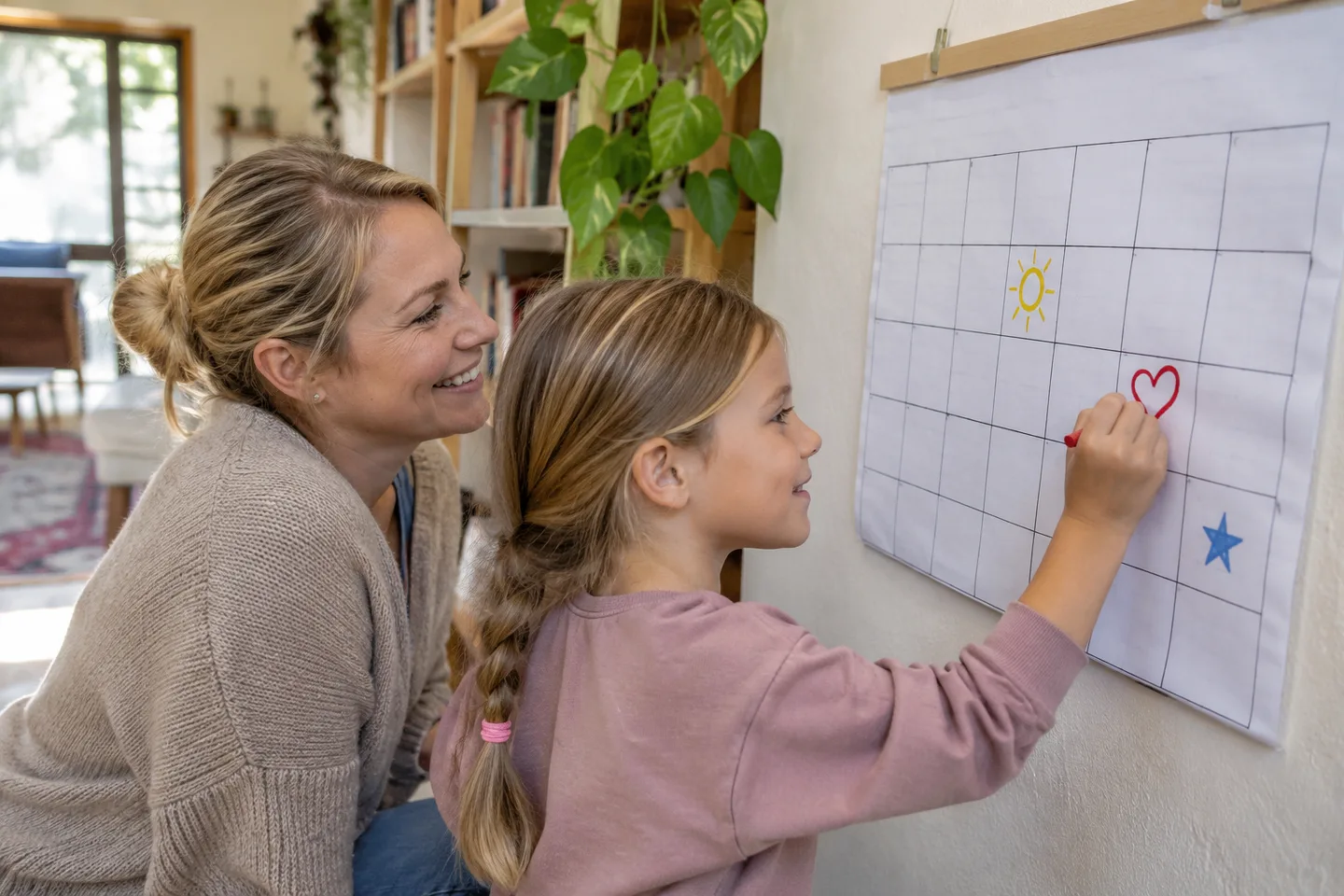
A child asks whether the library visit is tomorrow, then asks again after lunch. The word tomorrow can feel clear in adult conversation while remaining difficult to place in a child's picture of the week. A paper calendar gives that question somewhere visible to land. It can show what has happened, what is next, and how many ordinary days lie between.
The most useful family calendar is not necessarily the most detailed. Too many entries can make it harder for a child to find the one event they care about. Begin with a small number of relevant dates and a way to identify today. The calendar should answer practical questions, not become another household display that only an adult can interpret.
Choose a view that matches the question
A weekly page may be easier when the child mainly wants to know what happens next. A monthly page can show birthdays, recurring activities, or a longer wait. Try one view before adding another. If a full month seems crowded, cover the unused rows temporarily or make a separate strip for the coming seven days.
Use a stable place where the child can look comfortably without climbing. An adult should manage wall fixings and any small magnets or pins. A calendar lying in a folder on a low shelf can work just as well as one on a wall. Accessibility matters more than whether the arrangement resembles an organized office.
Connect symbols to events the child knows
Add a simple book picture for a library visit or a large dot for a family celebration. Agree on the symbols together. Keep a small key if needed, but avoid a complicated color system. The child should be able to explain at least the entries that concern them. Words and pictures can sit together as their reading develops.
Do not include private information that visitors or photographs might expose. A family calendar does not need full addresses, account details, or personal appointments displayed in a shared image. Keep sensitive notes elsewhere. The child's version can show the useful outline of an event without becoming a public record of the family's movements.
When two events share a day, explain their order with a simple note or separate spaces in the date box. A child may otherwise imagine that both happen at once. Connect the order to familiar anchors such as before lunch and afterward. Use only the detail the child needs; a full hourly schedule can add confusion when the question concerns just two activities.
Make today easy to find
Use a large paper marker or another age appropriate method to indicate the current day. Move it together at a consistent natural moment, such as after breakfast, without turning it into a compulsory ceremony. Say the day and connect it to something real. “Today is the day we return the books” gives the label a practical meaning.
If you forget to move the marker, correct it openly. The calendar is a tool that people maintain, not an infallible source. You can count forward from the last marked day together. Avoid presenting an overlooked update as the child's responsibility unless that was clearly agreed and suited to their abilities.
Count days with a clear starting point
When a child asks how long until an event, point to today and explain which days you are counting. “We have two sleeps before the visit” may be useful for some younger children, while others prefer touching the intervening date boxes. Use the method that makes the interval clearest for this particular question.
Be aware that inclusive counting can confuse the conversation. Are you counting today, the event day, or only the days between? Say what you mean rather than assuming the number alone settles it. Move a finger along the sequence together and connect each box to an ordinary day. The visual route is often more useful than repeating a number.
Keep plans separate from promises
Calendars show intentions, but plans sometimes change. Mark uncertain events differently or use simple language such as “we hope to go.” If an event is canceled, update the calendar with the child and acknowledge disappointment. Leaving the old entry visible after circumstances change can make the tool less trustworthy and create avoidable confusion.
Explain the reason at an appropriate level. “The library is closed that day, so we will choose another day” is enough. Invite the child to help identify a possible replacement if there is one. Do not promise an alternative you cannot reasonably arrange just to remove the immediate feeling. A changed plan can be clear without being instantly pleasing.
Use the calendar to prepare one small action
A date becomes more useful when it suggests something to do beforehand. Before a library visit, check which books need returning. Before a family picnic, set aside a suitable bag. Keep preparation manageable and relevant. The calendar is not a reason to add a long checklist to every event in a child's week.
Ask when the action should happen. A child may suggest gathering books the evening before rather than at the door. Put a small note in that day's box if helpful. This connects planning with an actual task and gives the child a chance to see whether the chosen timing made departure easier.
Notice repetition without filling every space
Recurring events can help children see patterns: a particular activity happens on the same weekday, while another occurs less regularly. Point out a pattern when it answers a question. Avoid adding activities merely to create an impressive looking schedule. Blank days are real parts of family life and do not need to be presented as wasted space.
You can mark open time with a simple symbol if the child finds uncertainty difficult, while explaining that the activity will be chosen later. “Home afternoon” can be a useful description without specifying every hour. The aim is enough information to orient the child, leaving room for rest, ordinary play, and changes in energy.
Let the child add information they can verify
An older child may enjoy copying dates from a school notice or adding a reminder. Read the source together and check the month, day, and any conditions. Ask them to show where the information came from. This makes calendar use a practical reading task rather than a test of memory or neat handwriting.
If an entry is wrong, correct it without drama. You might discover that the notice described a deadline rather than the event itself. Talk about that distinction and update the page. A calendar becomes more dependable through checking, and children can participate in that process without carrying responsibility for every family commitment.
Review what the calendar actually helps with
After a week or two, ask which questions the page answers and which remain confusing. You may need larger boxes, fewer symbols, or a shorter view. Remove features nobody uses. A simple calendar that the child consults is more useful than a complete system that requires repeated adult interpretation.
At the end of a month, look back at one or two events if the child wants to. Then turn the page. The purpose is not to preserve evidence of a busy life. It is to make time a little more visible, connect plans with preparation, and show that information can be updated when circumstances change. Paper and a few clear marks are enough to begin.
Keep spare pages nearby so that a crowded or confusing week can be redrawn without treating the first version as a failure. Invite the child to suggest one improvement before making the next page. Perhaps the symbol needs to be larger or the marker needs a clearer place. These small adjustments help the calendar remain a shared working object rather than an adult's finished design.
For general educational information. Adapt ideas to your family and consult a qualified professional for individual concerns.