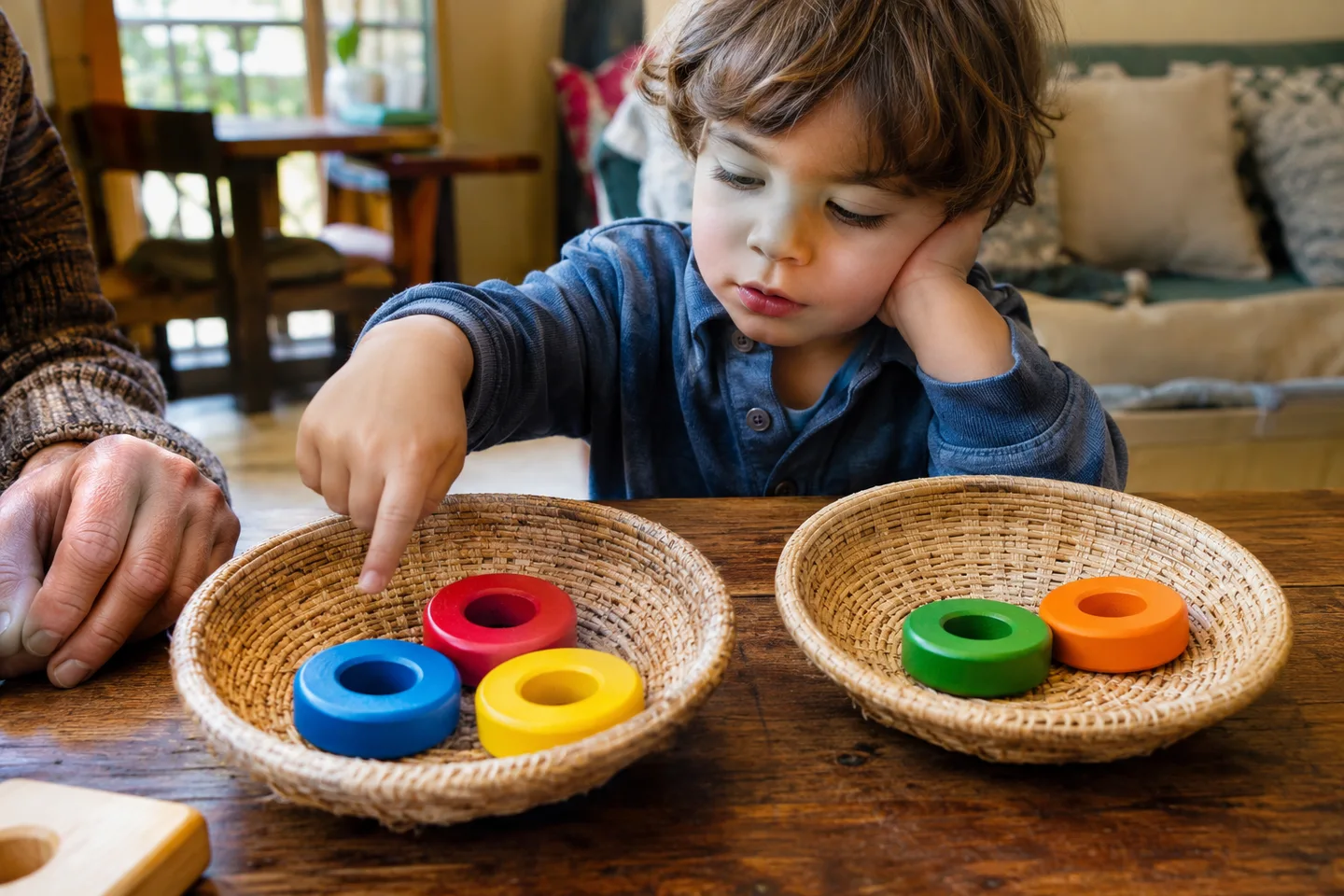
Two baskets sit on the table. One holds four large wooden rings and the other holds seven. Before anyone counts, ask which basket seems to have more. The child may point quickly, study the arrangement, or decline to guess. Each response offers a place to begin a conversation about how we judge quantities before we know them exactly.
Estimation is not a competition to be closest. In everyday life, people make rough judgments and then decide whether they need a more exact answer. A child can practise that distinction with a small, visible collection. The useful pattern is to look, make a reasonable guess, check, and notice what changed the judgment.
Choose safe objects with clear boundaries
Use large, age appropriate items that the child can handle comfortably, such as wooden rings, blocks, or rolled socks. Avoid small pieces around children who might swallow them. Keep the collection on a stable surface and supervise as you normally would. Two shallow containers help make each group visible without hiding objects underneath one another.
Begin with small groups that can be counted without a long session. For a younger child, compare two items with four. For an older child, use a larger collection or a more subtle difference. The right starting point is one where the child can inspect the objects and check a guess, rather than rely entirely on the adult's answer.
Explain what a guess is for
Say, “We can look first and count afterward.” This separates the rough judgment from the check. If the child asks whether being wrong matters, explain that the count will give you information either way. Avoid rewarding the nearest guess with a prize or treating an inaccurate answer as evidence that the child was not paying attention.
Offer your own estimate when useful. Explain one visible reason: “I think that basket has more because there are objects across the whole bottom.” Keep the language tentative. Your guess may turn out to be wrong, and that is a useful chance to model revising an idea in response to what the count shows.
Try a comparison where the objects differ in size as well as number. Keep the quantities small enough to check easily. Ask whether the question concerns how many objects there are or how much space they occupy. A basket with three large blocks may look fuller than one with five smaller blocks. Naming the question helps explain why two reasonable observations can lead to different answers.
Ask for a reason without demanding a speech
A child may say one group looks bigger. Ask what they noticed: the number of spaces filled, the length of a row, or the amount of empty space. A point can be enough. You are making the basis of the judgment visible, not asking for a formal explanation before the child is allowed to continue.
If the child cannot offer a reason, describe possible clues without choosing for them. “I can see one group is spread out and the other is close together.” Then wait. Some children become more interested after handling the objects. You can invite them to rearrange each group before they make another estimate.
Check in a way the child can follow
Count by moving each item into a clear line or another container. This makes it easier to see what has already been counted. Say one number for each object and use the final number to describe the group. If the child loses track, start again calmly with fewer items. The check should clarify the question, not introduce a new struggle.
Compare the result with the original estimate. “We guessed six, and counted seven.” Ask what made the group hard to judge. Perhaps one ring was partly hidden or two pieces overlapped. Avoid focusing only on the size of the numerical difference. The visual reason can help the child make a more informed judgment next time.
Change the arrangement while keeping the collection
Spread one group across a wide area and gather the other into a small cluster. Ask whether the number of objects changed. Count or match them again if needed. This simple alteration can reveal how strongly spacing influences an initial impression. Let the child do the rearranging too, rather than presenting it as an adult trick.
Use language that respects the first judgment. “It looked like more when they were spread out” describes an understandable visual effect. Do not laugh at the child for being fooled. Adults also rely on appearances and need to check. The point is to discover which clues are reliable for the particular question.
Connect a rough answer to a practical decision
Set out a few large paper circles to represent places at a toy picnic. Ask whether the basket seems to have enough rings to give one to each place. Make an estimate, then match objects to places. This connects the judgment to a decision: do you need more items, fewer places, or another way to share?
Keep the situation imaginary if real food or household materials would complicate it. A drawing can stand for a plate and a block can stand for an item. Explain the pretend meaning clearly. The learning comes from considering whether an approximate judgment is sufficient and when a direct check is worth doing.
Offer ranges when one number feels difficult
Some children find a single estimate intimidating. Ask whether the group is likely to contain fewer than five or more than five, then check. An older child might suggest a range such as eight to twelve. This keeps attention on reasonable scale rather than an exact prediction, and it gives a different way to participate.
You can narrow a range together using a known group. Put five objects beside the unknown collection and compare. Does the new group look close to five, twice as large, or somewhere between? Keep the reference visible. This is an opportunity to reason from something known, rather than simply make another unsupported guess.
Avoid turning quantity games into judgments about ability
A child who guesses accurately on one day may be distracted on another. Different objects and arrangements also change the task. Do not use a few estimates as a measure of mathematical talent or development. Notice the strategies instead: comparing with a known group, checking hidden objects, or changing the arrangement to see more clearly.
If the child wants to stop, finish with the count you already have and put the materials away. There is no need to keep producing new groups until the estimate improves. A short, successful exchange may simply mean the child has seen that checking can change an answer without creating embarrassment.
Carry the habit into ordinary questions
Later, ask whether there seem to be enough books to fill a shelf or enough large blocks to finish a road. Check when the answer matters and leave some questions approximate when it does not. Explain the distinction. A rough idea may help you plan, while an exact count may be needed to distribute one item to each person.
The lasting habit is not quick guessing. It is a willingness to state what seems likely, look for evidence, and revise the judgment. Two baskets on a small table can make that process visible. When a child says, “I thought there were more, but they were just spread out,” the conversation has already reached a useful place.
Save one interesting arrangement for the child to show another family member if they want to. Let them ask the question and explain the check. Taking the role of questioner can reveal whether the comparison is clear enough for someone else to follow. Keep the exchange playful, and let the child choose whether to disclose the number before or after the listener has made a guess.
For general educational information. Adapt ideas to your family and consult a qualified professional for individual concerns.