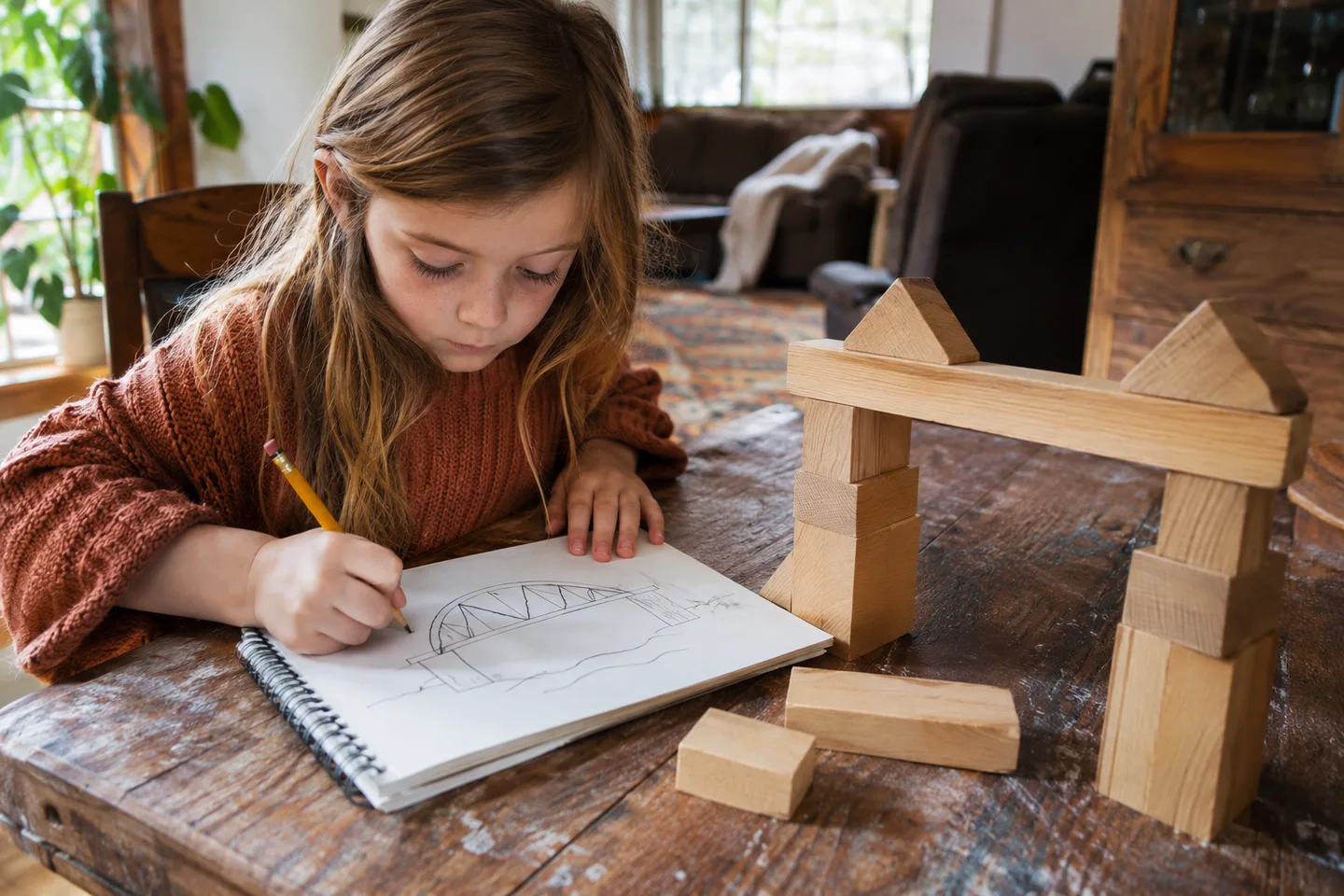
A child announces that the blocks will become a bridge. They can see the finished structure in their imagination, but the person helping cannot. A quick drawing offers a way to put part of that idea where both people can look at it. It need not be accurate, attractive, or complete to be useful.
Drawing a plan is an invitation rather than a required first step for every kind of play. Some children think best while handling materials, and many projects can begin directly with building. Offer paper when the child has a goal that would benefit from remembering or explaining. The plan should serve the project, not delay it until an adult approves.
Choose a small project with a visible purpose
A bridge for a toy vehicle, a shelter for a large toy animal, or a bookstand made from suitable blocks gives the drawing something to describe. Keep the project within the child's available materials and your normal safety rules. Use stable surfaces, age appropriate pieces, and adult supervision. Avoid building anything intended to carry a person's weight.
Ask what the structure needs to do. A bridge might need room underneath and a path across the top. A shelter may need an entrance wide enough for the toy. These practical requirements are easier to draw and test than an abstract instruction to make something impressive. Let the child choose one or two features that matter most.
Offer a drawing tool that feels easy
Use plain paper and a pencil or broad crayon. A large sheet may help a younger child, while an older child might prefer a notebook they can return to. There is no need for special drafting equipment. If the child dislikes drawing, invite them to arrange a few blocks first and trace or describe the arrangement instead.
Begin with “Show me where the vehicle will go” rather than “Draw a proper bridge.” A line can represent a road, and two rectangles can stand for supports. Ask the child to explain their marks. The explanation may contain important ideas that the picture alone does not show. You can add dictated labels if they want help preserving those details.
Keep adult drawing separate
It is tempting to take the pencil and make the plan clearer. Before doing that, ask permission. If you have a suggestion, draw it on another sheet or use a finger to indicate the area you mean. The child should be able to distinguish their original idea from an adult's contribution and decide which parts to use.
You can model uncertainty on your own drawing. “I am not sure how high these supports need to be.” That statement leaves room for testing. Avoid presenting a polished adult diagram as the correct answer the child should copy. The value of the plan lies in helping them express and examine an idea they are actually interested in building.
Move between paper and materials
Once a few features are visible, begin building. Keep the drawing nearby but do not demand exact copying. The materials will reveal possibilities and difficulties the child could not see on paper. A long block may be missing, the supports may be too close, or the toy may be wider than expected. These discoveries give the plan a practical role.
Pause at a natural point and compare. “Your picture has two supports. We have built three. What changed?” The answer may show a useful adjustment. If the child has abandoned the drawing entirely, ask whether they want to update it or put it aside. A plan is a working aid, not a contract that prevents sensible changes.
Test the feature you chose
For a toy bridge, slowly move the vehicle along the intended path while keeping hands clear of unstable pieces. Does it fit? Does the bridge stay in place? For a shelter, place the toy inside and check the entrance. Keep tests gentle and suitable for the materials. An adult should stop any unsafe extension immediately.
Talk about the observed result in specific terms. “The roof touches the toy's head” is more useful than “It failed.” Ask what could change and let the child choose an approach. Perhaps the supports need to be taller or the roof needs a different shape. Return to the drawing if it helps compare the options before rebuilding.
Record changes without erasing the story
A second color can mark an adjustment on the original plan. Alternatively, make a new drawing beside it. The first version does not need to disappear. Looking at both can show how the idea developed: the entrance widened, the supports moved, or the road became shorter. This record is about decisions rather than artistic progress.
If the child wants to erase everything, that is also a choice. You might ask whether they would like to keep one small note about what they learned before changing it. Do not turn preservation into another demand. Some children enjoy revisiting earlier versions, while others prefer to concentrate on the structure in front of them.
Use conversation to reveal hidden assumptions
A plan may show a road that appears to end abruptly. Ask where the toy goes next. The child might explain that the end is a tunnel, a turning point, or a place they have not considered. Open questions give them room to clarify. Avoid treating every missing feature as an error requiring correction.
You can also ask what another builder would need to know. If a sibling joins the project, let the child use the drawing to explain one part. Notice where the listener needs more information. The child can add a mark, point to a block, or demonstrate. Drawing becomes one tool among several for communicating a practical idea.
Adjust for the child's interest and energy
A younger child may make one mark and then build immediately. An older child may enjoy a view from above, a list of materials, or measurements made with a ruler. Offer these possibilities when they solve a real problem. Adding more detail simply because the child is older can make an enjoyable project feel unnecessarily formal.
If drawing causes frustration, let the child dictate a plan or photograph a trial arrangement for private family use. Planning can take several forms. The important experience is deciding something before acting, checking what happens, and revising when needed. None of those experiences requires a particular style of picture or a long period at the table.
End with one decision worth remembering
Ask what changed between the first idea and the final structure. Your child might point to a wider opening or explain why an extra support was needed. Write down that observation only if they want you to. Then let the structure return to play, or dismantle it when the shared room needs to change purpose.
Keep a few plans in a folder if the child enjoys returning to them. They can become prompts for a later project rather than evidence of a developmental score. A rough drawing has done enough when it helps a child make an idea visible and use what the materials reveal. The finished bridge may come apart, but the experience of changing a plan remains available for the next attempt.
Before leaving the table, give the child a chance to explain the project to someone who did not watch it being built. A short explanation can reveal which features they consider most important. Let them use the drawing, the model, and gestures together. There is no need to rehearse a perfect presentation; an interested listener and one genuine question are enough to give the plan another useful job.
For general educational information. Adapt ideas to your family and consult a qualified professional for individual concerns.