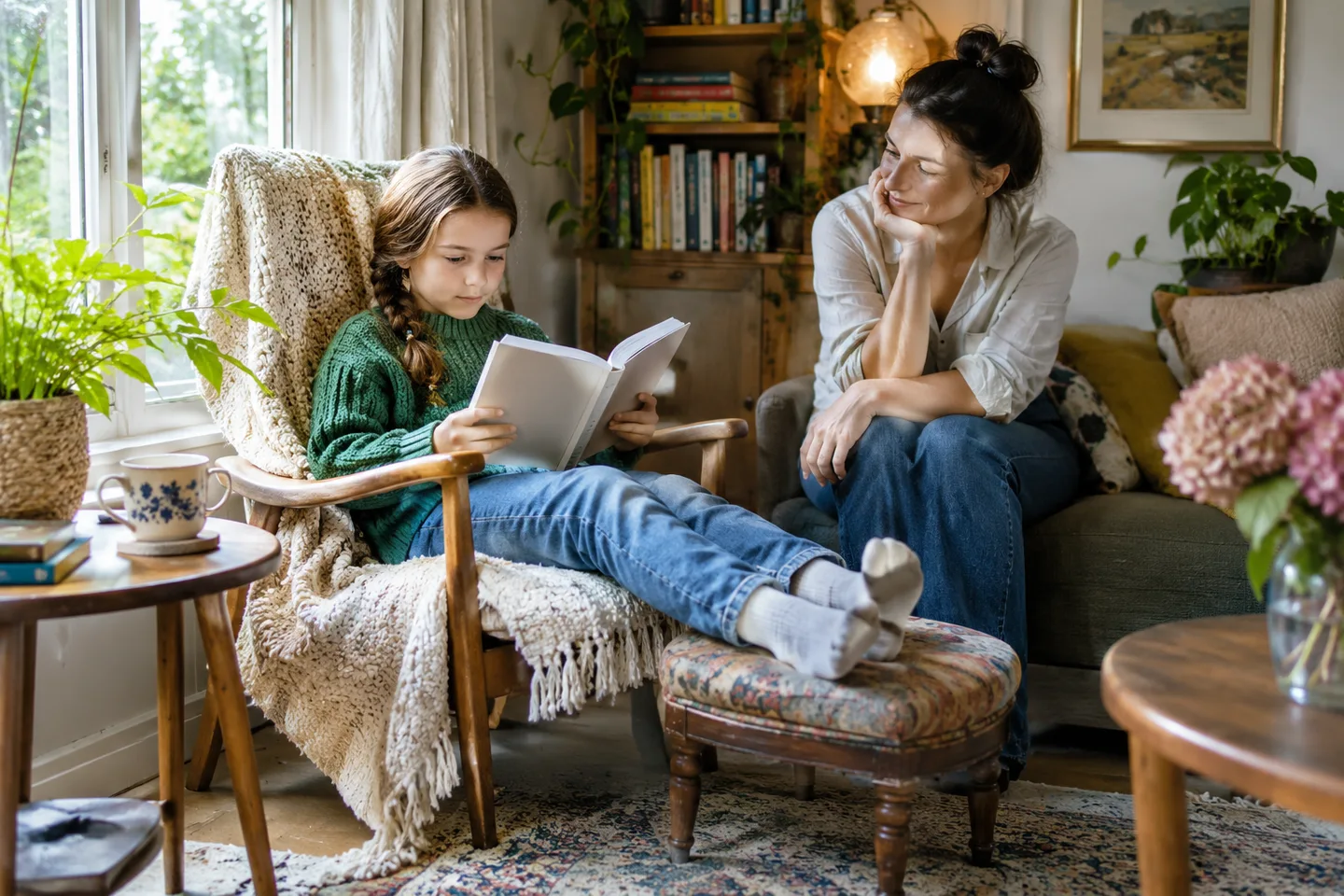
A reading corner can be a chair, a cushion, or one end of a sofa. It does not need a tent, decorative lights, or a special shelf to feel inviting. In a small home, the most useful version is a place where a child can settle with a book and where the arrangement can coexist with everyday family life.
Begin by watching where your child already chooses to look at books. They may prefer being close to an adult rather than tucked away. They may need a firm surface for a large picture book or a little support under their feet. A comfortable place grows from those observations, not from a fixed picture of what a reading nook should look like.
Choose a place with ordinary access
Pick an area the child can reach without climbing or squeezing past furniture. Keep doors, walking routes, heaters, electrical equipment, and other hazards clear. Any furniture or shelving should be used and secured appropriately. Avoid hanging materials or loose fittings that could create risks. An adult should make the practical safety decisions before inviting the child to arrange details.
The place can be temporary. A cushion brought to a familiar chair after lunch may be enough. If the space changes purpose later, keep the reading materials in a portable basket. A corner that is easy to set up and put away may be more useful than a permanent arrangement that blocks other activities.
Look at the light on the page
Sit where the child will sit and open a book. Is the page easy to see? Does a window create glare? Does your own body cast a shadow over the words? Small changes in position may help. Aim for comfortable, even illumination and follow normal household precautions for lamps, cords, and fittings.
If artificial light is needed, an adult should choose and position it safely. Avoid makeshift arrangements with trailing cables or unstable lamps. You do not need dramatic mood lighting to make reading feel special. Clear visibility and a comfortable place to hold the book are practical priorities, especially for a child looking closely at illustrations or learning to follow print.
Support the way the child holds a book
A large picture book can be awkward in a small lap. Try a table, a firm cushion, or reading beside an adult who can share the weight. A child seated on a chair may feel more settled with a suitable support under their feet. Choose stable arrangements and watch what the child finds comfortable rather than enforcing a single posture.
Children may change position while reading. Some like sitting upright for a detailed page and leaning against an adult for a story. Allow reasonable movement within the space. If a position seems uncomfortable, offer another option without turning reading into a series of corrections about how the child should sit.
Keep a few books within reach
Offer a small selection that the child can see and remove easily. Face out one or two covers if that helps, but do not crowd the area until books fall or become difficult to return. A familiar favorite and something less familiar can provide choice without requiring the child to search through a large pile.
Rotate the selection in response to interest. Repeated reading is a valid choice, and a book does not need to disappear because an adult thinks it has been read enough. If the child repeatedly ignores one title, return it to the wider collection. The corner should make choosing easier rather than advertise a set of books adults wish the child preferred.
Decide what company is welcome
Ask whether the child wants to read alone, beside someone, or with an adult reading aloud. Preferences may vary from day to day. A place near family activity can feel more comfortable than an isolated corner. Do not assume that quiet independence is the ideal form of reading for every child or every moment.
When reading together, share the view of the page. Pause when the child notices something, and avoid rushing to finish a book simply because you started it. A single spread can support a satisfying conversation. The physical corner is useful when it makes that shared attention easier, not when it encourages a rigid routine detached from the reader's interest.
Manage interruptions with a modest agreement
In a shared room, other people will sometimes pass, talk, or need the seat. Agree on a short reading period when that helps. A sibling can ask before taking a book from someone's hands, and an adult can give a warning before the area needs to change purpose. Keep the agreement realistic for the household.
Avoid promising complete silence if it cannot be maintained. Instead, distinguish ordinary background sound from direct interruption. If a particular task needs quieter conditions, choose a more suitable time or location. A reading corner should reduce friction, not make everyone else feel they must stop using the room whenever a book is opened.
Make returning books easy
A child should be able to put a book back without balancing a leaning stack or fitting it into a crowded gap. A low, stable basket or an accessible shelf can help. Adults should handle heavy volumes and maintain the storage safely. Keep borrowed books together if that makes them easier to find before a library return.
Care for books through small practical actions. Show how to turn a page gently, keep drinks in another suitable place, and use a bookmark if desired. If a page tears, repair it together when appropriate. Avoid making damage so emotionally charged that a child becomes anxious about touching books. They are objects intended to be used.
Keep decoration secondary
Let the child choose one small personal touch if they want one, such as a drawing placed nearby. Check that any decoration is suitable for the space and securely arranged by an adult. There is no need to buy a themed collection or add fabric structures. The book, the reader, and the light already give the place a purpose.
Too many objects can make a compact area harder to maintain and less comfortable to enter. Leave room to change position and place the book down. If the child brings a favorite soft toy, make sure it does not crowd the reading surface. A simple place is often easier to adapt as books and preferences change.
Review comfort through use
After several sessions, ask what feels good and what is awkward. Does the book slide? Is the basket too far away? Does the child prefer another chair? Try one adjustment. You do not need to preserve the original arrangement because you spent time creating it. The best evidence is how comfortably the child uses the space.
A useful reading corner may eventually move to the other end of the sofa or become a basket carried between rooms. That is a sensible evolution. Its purpose is to make books available and reading physically comfortable within the home you have. When a child can choose a book, settle in, and ask for company or space, the corner is doing its work.
Leave room for the child to choose a different place occasionally. Reading at the kitchen table or beside an adult in another chair does not mean the corner failed. The arrangement is a resource rather than a rule. What matters is that a comfortable option is ready when it is useful, with books that can be reached and returned without a complicated setup.
For general educational information. Adapt ideas to your family and consult a qualified professional for individual concerns.